
 MENU
MENUGuide to Performance clutches, and clutch problems.
"Clutching at straws!"
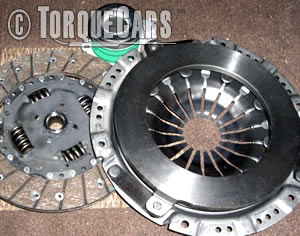
The clutch takes the engine power and connects this to the drive shaft, and onto the driven wheels on the road.
It also allows you to disengage the engine whilst performing a gear change.
Clutches that slip will lose power and you need a lot of grip and a fast response in your clutch.
The more torque your engine produces the harder it is for the clutch to bite and hold.
It takes more effort to bite than hold which is why clutches are more likely to slip as they are engaged.
Power and performance clutches have very high friction surfaces, are created to cool more quickly , and sometimes have 2 (double) or 3 (triple) contact plates.
Heavy-duty race clutches are more brutal in operation and are pretty much on or off.
This makes it hard to drive smoothly in traffic and pulling away smoothly on a hill requires a fair bit of leg muscle and control.
The clutch release spring is somewhat heavier on most race clutches and a TorqueCars member found to his cost that clutches and cables need to be perfectly aligned or they will fail quickly.
A fast road power clutch makes good sense for everyday road use. Don't be tempted by the high spec multi plate race solution, unless you have substantial power to contend with, as it is not very well suited to domestic driving for most vehicle types.
Most clutches come with a power rating - if your engines output is greater than the rated power of the clutch you will experience clutch slip (see below for explanation) while you are accelerating and the clutch will wear out very quickly.
Sometimes a clutch will last well on a power upgrade and other times will fail miserably.
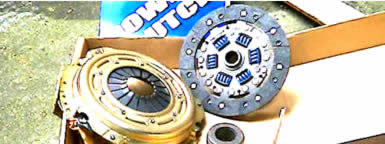
Clutch replacement is relatively straightforward if you have the right tools. (Although complete removal of the gearbox and or engine on some cars is required!)
I would still recommend consulting a specialist or someone with a similar car to ask for their feedback on your requested application before your spend the money and end up with an impractical daily drive.
Badly fitted clutches will usually fail very quickly, they must be aligned and you need to replace all parts of the clutch assembly, not just the friction plates.
What is Clutch Slip
When you accelerate you see a rise in engine speed but no pull on the car, you may also note a burning smell.
It may also squeal and take a while to engage after a gear change. Clutch Slip is a bit like pulling a table cloth off a table and all the crockery staying in place.
Being slower with the clutch will help it to bite, but severe heat build up reduces its ability to grip.
A power clutch has more grip and hold due to its much stronger tension between the two plates and will eliminate clutch slip. (A bit like trying the table cloth trick when the crockery has been glued down and the force of gravity has been doubled.)
Clutch judder
The clutch does not engage properly causing a kangaroo start or intermittent power to the wheels while the engine is engaged. To address this you need to check your
1) Driving style 'the clutch operation should be smooth not sudden',
2) The clutch release mechanism (cables, spring and bearing)
3) The flywheel, especially a damaged dual mass flywheel can cause judder or vibration
Diagnosing clutch problems
I had a Toyota with a worn release bearing - this meant that the clutch did not fully release the engine from the gearbox causing clutch drag. Gear changes became more and more notchy - particularly the 1st and 2nd gear.
A new clutch almost sorted the problem but permanent damage to the synchromesh has been done and 1st remained notchy. Get a problem sorted out as soon as it manifests itself.
When adjusting a hydraulic clutch remove the mats from the car - particularly if they are thick because this can reduce the pedal travel significantly and will make the clutch appear to wear out much sooner.
How to tell if the clutch is going
As the clutch wears out it will usually start to slip or even seem sticky, not fully engaging or disengaging. Initially just First and then Second gear will become increasingly hard to select.
Eventually the car will stall every time you try to put it in gear from stationary (if your lucky 3rd and 4th might still work and you can limp to a garage). New clutch - New Cable - New release bearing DO NOT CUT CORNERS!
If your clutch has gone you can generally engage 3rd and 4th easily without using the clutch if you carefully match your engine speed to the gear you select 'providing the car is moving'.
I drove 400 miles including a stint on the M25 with a dodgy clutch cable changing gear just 20 times, and because I didn't stop the car and kept in 3rd and 4th gears I got home - I consider myself to be really lucky.
Don't forget that the clutch can become 'stuck on' when the hydraulic fluid leaks from a hydraulic operated clutch, and, it can also slip if the master or slave cylinder sticks.
A much easier job replacing either the master or slave cylinders than the clutch so investigate this first.
One other thing when you do replace a clutch is to watch out for the release bearing 'cage' which is usually plastic nowadays.
One TorqueCars member replaced a clutch on a Lancia Thema and the new cage they gave him was slightly thicker than the old one!
This resulted in having to do the job twice when, after assembly, the car crawled forward with a mega slipping clutch because it was not fully released!
A clutch cable stretching can also cause similar symptoms to a faulty clutch. Join us in our forum to discuss your clutch problems in more detail with our friendly and enthusiastic members.
Please Check out my YouTube channel, we're regularly adding new content...
 Click to accept YouTube Cookies & Play.
Please share this page with your friends on :


PLEASE HELP: I NEED YOUR DONATIONS TO COVER THE COSTS OF RUNNING THIS SITE AND KEEP IT RUNNING. I do not charge you to access this website and it saves most TorqueCars readers $100's each year - but we are NON PROFIT and not even covering our costs. To keep us running PLEASE Donate here
If you liked this page please share it with your friends, drop a link to it in your favourite forum or use the bookmarking options to save it to your social media profile.
Feedback - What do You Think?
Please use our forums if you wish to ask a tuning question, and please note we do not sell parts or services, we are just an online magazine.
Help us improve, leave a suggestion or tip
Please watch this video and subscribe to my YouTube channel.
5 Responses to “Clutch tuning: performance clutch modifications and triple plate clutches setup”
I have a 2008 Nismo 350z and just installed a ACT clutch and AASCO light weight flywheel, New pilot bearing, but stayed with the Stock throw out bearing. Below 2k rpm the cluch chatters and sounds really bad, I was told by a. mechanic that this is normal,the original flywheel has a harmonic dampner on it and the new flywheel.is solid and there is no fix for this, any ideas?
Any lightened flywheel will cause chatter,less weight.Its something you got to live with,for the benefit of performance. Pretty much any vehicle built around performance is not going to be quiet.
Just bought a stage 2 compition clutch for my mk 4 golf hybrid,can you advice which flywheel is best to install,dual mass or single mass cheers
There is much debate over this question, have a read of our article which should hopefully highlight the pros and cons of a DMF to solid conversion.
http://www.torquecars.com/tuning/dmf-solid-flywheel.php
One item that is often forgotten when clutches are replaced is the spigot bearing that locates the front of the gearbox input shaft in the flywheel.