
 MENU
MENUCar Batteries
"Charging ahead."
 Does the battery have much of an impact on the performance of a car?
The short answer is no, not really, but a weak battery can cause problems.
The battery should be viewed as a power buffer and needs to be chosen to match the load put on the electrical system by the car.
The alternator produces the charge required to run the engine and the battery stores the power for the starter and provides a steady current.
Ideally the load on the battery should never be greater than the (13v) power supplied by the alternator.
A good battery will enable you to run longer under high drain conditions. In a performance engine your will be requiring more spark and a bigger spark. You may also be running an electric water pump and electric power steering, both of which cause extra drain.
The injectors are also putting a drain on the battery as is the fuel pump. Add to this the heater and other electrical circuits from the clock to the radio you start to appreciate the immense drain put on a car battery.
This can all quickly drain the battery and in the case of modern cars with alarm systems and all manner of electronic gadgets from wipers and window winders to engine management you can be left with insufficient power to start the car.
Generally speaking your alternator is more critical than the battery. A weak battery will usually manifest itself in colder weather when the electrolyte is under the most strain and the driver puts more load on the power using the wipers and rear heater.
Remember that if you are taking the charge from the alternator there is very little feeding back into the battery and if there are plenty of short journeys you will be draining the battery.
A good quality battery will ensure that there is sufficient power and a regular flow of current around the cars circuit.
When you suspect a failed battery always get the charge system checked. Often the alternator is failing to correctly charge the car.
Choosing a car battery
The battery will have an Ah rating which means it will supply a steady x amps for 10 hours. So a 40Ah battery can provide a supply of 4A for 10 hours.
Another rating is the reserve power which shows how many minutes the battery can provide a 25A flow at a temperature of 25oc which effectively tells you how much cranking power is there to start the car. It also shows the life of the charge which is useful on high drain cars like diesel engines, or cars with sophisticated security systems which are constantly on.
How does a car battery work?
A cell typically comprises (typically) of 2 Lead/Antimony alloy plates in a Sulphuric Acid/distilled water electrolyte. A current flows from one lead plate through the electrolyte to the other. Car batteries are made up of a row of these cells typically 6 cells rated at 2 volts each. A drop in the level of the electrolyte will substantially reduce the power of the battery.
You can check the amount of charge in the battery by using checking the gravity of the electrolyte with a hydrometer.
Modern cars now have the option of a sealed maintenance free battery where there is no need to top up the electrolyte. Most have an indicator on the top which is colour coded to indicate the state of the battery and when it needs replacing.
As with most items you get for you car the old adage, "you get what you pay for", always rings true. Get a good quality battery. Generally speaking the longer the warranty offered with the battery the better it will be.
The essentials for choosing a car battery are the physical dimensions and shape/size of the terminals. All car batteries will generally provide the 12Volts required. Many diesel cars have greater demands placed on the battery so a bigger amperage is quoted but this is the cranking power and more is better, giving you a stronger reserve.
Most of the twin battery setups we have seen installed on cars where high power ICE installs have been fitted could be simplified to a better quality battery/alternator with a larger reserve capacity.
Batteries have a life span from a few years to over 10 years. TorqueCars have often seen cars with the original battery still performing well in cold weather. A lot depends on the usage of the car and the drain/charge cycles it is subjected to.
Car battery charging tips.
When charging always do so in a well ventilated area as batteries give off poisonous hydrogen gas. Most NON maintenance free battery manufacturers recommend that you remove the plugs whilst charging. Maintenance free batteries should generally not be charged or jumped if they are showing a yellow fault light.
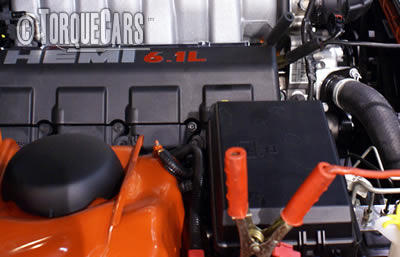
You should also avoid charging the battery in very cold weather if there is a danger of freezing.
You should also avoid charging the battery if the electrolyte temperature raises above 44oc.
Slow charges usually give better results and do not deteriorate the condition of your battery as much as some fast chargers.
The battery should not be overcharged and most good chargers will switch off when it is fully charged.
When using a high voltage booster to start your car always follow the instructions carefully. It has been known for the sudden surge to damage the circuitry around the alternator. As with jump starting a car the battery should be isolated and the boost charge fed into the battery and then the battery is connected to the car where it will have enough charge to start the engine.
If a battery is over charged, perhaps due to a faulty voltage regulator the electrolyte will bubble and spit. This will cause harmful battery acids to leak out of the battery into the engine bay. The first victim is usually the battery tray so this should be regularly inspected for signs of corrosion.
If you experience a power failure get the whole electrical charge system checked. Many power problems are actually charge issues rather than a battery fault. A bad battery will have trouble holding its charge in cold weather and is something more prone to affect low mileage or infrequent drivers.
A few words of caution
Battery Acid causes severe burns. If splashed on the skin you should immediately apply sodium bicarbonate solution or rinse with plenty of clean water. If splashed into the eye you should also rinse the eye in clean water.
Always SEEK MEDICAL ATTENTION to prevent and minimise further injury. You should wear gloves and goggles when handling/pouring or carrying battery acid unless it is in a sealed container. Special care should be taken if the battery spits or splatters whilst charging.
Modern vehicles are often dependent on the battery for security and the ECU and these functions may well need resetting when the power is switched back on. Check the procedure for resetting the alarm/immobiliser/radio code before you disconnect the battery.
An ECU will generally need 200-300 miles to relearn the engine airflow/ignition settings so may appear lumpy at first. It has also been noted that some electronic automatic transmissions will also need to relearn their settings. If concerned please consult your manufacturers handbook or your dealer.
Please Check out my YouTube channel, we're regularly adding new content...
 Click to accept YouTube Cookies & Play.
Please share this page with your friends on :


PLEASE HELP: I NEED YOUR DONATIONS TO COVER THE COSTS OF RUNNING THIS SITE AND KEEP IT RUNNING. I do not charge you to access this website and it saves most TorqueCars readers $100's each year - but we are NON PROFIT and not even covering our costs. To keep us running PLEASE Donate here
If you liked this page please share it with your friends, drop a link to it in your favourite forum or use the bookmarking options to save it to your social media profile.
Feedback - What do You Think?
Please use our forums if you wish to ask a tuning question, and please note we do not sell parts or services, we are just an online magazine.
Help us improve, leave a suggestion or tip
Please watch this video and subscribe to my YouTube channel.
One Response to “Car batteries, battery care and charging tips”
If I hook my battery charger to a car battery and the battery is sitting on a concrete floor. Does this ruin the battery?