
 MENU
MENUAll you need to know about remote turbo kits
"What are the benefits of Remote turbo kits?"
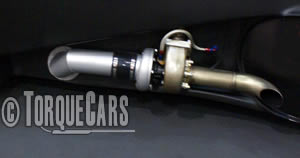
If you have limited engine bay space or just want an easy retrofit turbo option you will do well to consider a remote turbo kit.
What are the advantages and disadvantages of remote turbos and how do they work?
Usually the turbo is mounted on the engine exhaust header/manifold, if there is space and it can cope with the heat.
This is where a remote turbo differs as it is fitted much further down the exhaust pipe.
Usually a remote turbo will be fitted at the rear of the vehicle just before the rear silencer, or sometimes on the underside of the car if there is sufficient clearance. We have seen these on the side of a car or just under the gearbox behind the engine.
A remote turbo follows the same operational principles as a conventional turbo, but is just further away from the engine bay.
Temperatures are lower as the exhaust has dissipated much of the heat, the longer runs also mean the boost levels are lower and the spool rates are lower. It can make mapping the turbo easier and offers a simple low boost turbo solution where engine bay space is limited.
The intake air is then channeled back from the turbo compressor to the front of the car and into the engine. Despite the length of the run the delivery is to all practical purposes instantaneous with only a minor loss in boost pressure if the pipe work is in good condition.
To fit a remote turbo kit
You will need to cut into the exhaust and direct the exhaust flow into the turbo intake. A heat shield may also be required, especially if the turbo is going to be mounted near the fuel tank.
You'll also need to reroute the engine intake through the remote turbo and we strongly recommend good quality pipes are used, preferably metal but high quality silicone hoses can also work and are easier to fit. It does mean the air intake can be near the rear of the car to avoid the hot engine bay temperatures and a double run of pipe from the air filter to the turbo and back again.
Unless you opt for an oilless turbo it will need a supply of oil, either it's own pumped supply with cooler or taking a feed from the engine oil.
Next you will need to adjust the fuelling and timing, a specialist job. A remap on a rolling road is your only option if you want to avoid blowing up the engine and want to extract the maximum amount of power from your mods. Injectors will also need to be uprated and most standard air filters will be unable to flow enough air where a turbo has been added.
Safety systems will need to be added. If the turbo runs too hot or the oil line cuts out it would be detrimental to the turbo to keep the engine running.
Depending on the boost provided and your vehicles mapping, you will also need to factor in some further modifications to control the exhaust flow through the turbo in the form of a waste gate control and a diverter valve to cut in when you come off throttle to avoid overboost.
If you are running high boost levels you should either reduce the engines compression ratio or introduce other measures against detonation like direct injection or adding water injection and using higher octane fuel.
Thankfully the remote turbo is relatively simple in it's setup and tolerates a wide range of varying conditions compared to a conventional turbo.
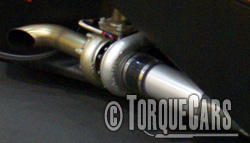
What are the advantages of a remote turbo?
They are generally easier to fit than a standard turbo (easier to map and installation space is normally more accessible) and due to lower temperatures they require less lubrication and cooling. Due to the length of the run back to the engine intake there is little need for an intercooler.
Their lower boost characteristics avoids many problems with detonation associated with adding a turbo to a conventional engine.
So what are the disadvantages of remote turbos?
They do not provide as much power as a traditionally mounted turbo would. It can reduce your ground clearance and may require additional heat shielding depending on where it is located.
The remote turbo is not shielded from stones and impacts under the car or on the side so adding a guard is generally a good idea. A a sturdy mesh or aluminum shield is a good idea but ensure it would still allow plenty of airflow around the turbo housing.
You can source a cheap turbo unit from a breakers yard, then it's just a matter of fabricating the piping and exhaust flow yourself and setting up the timing/fuelling. (TorqueCars would not recommend using a diesel turbo unit on a petrol engine as these are setup for much lower exhaust flow rates and lower temperatures.) Remote turbos work really well on large block V6 and V8 engines but we have seen applications and kits that will work on lesser cars.
We would recommend starting off with a very low boost setting and running the car on a rolling road with diagnostic equipment to monitor the air to fuel ratio and measure the risk of detonation. Gradually tweak the boost and mapping until you reach the optimum setting for the vehicle and then for safety and reliability back it off a little.
Join us in our friendly forum to discuss remote turbos, supercharger kits and any other imaginable application for forced induction.
Please Check out my YouTube channel, we're regularly adding new content...
 Click to accept YouTube Cookies & Play.
Please share this page with your friends on :


PLEASE HELP: I NEED YOUR DONATIONS TO COVER THE COSTS OF RUNNING THIS SITE AND KEEP IT RUNNING. I do not charge you to access this website and it saves most TorqueCars readers $100's each year - but we are NON PROFIT and not even covering our costs. To keep us running PLEASE Donate here
If you liked this page please share it with your friends, drop a link to it in your favourite forum or use the bookmarking options to save it to your social media profile.
Feedback - What do You Think?
Please use our forums if you wish to ask a tuning question, and please note we do not sell parts or services, we are just an online magazine.
Help us improve, leave a suggestion or tip
Please watch this video and subscribe to my YouTube channel.
6 Responses to “Remote turbo charger kit guide”
Hi there sorry about this
I was reading about your remote turbo kit and was wondering if you had a kit for the hyundai yf sonata 2.4l n/a engine
Sorry, I don’t know of any suppliers of kits for remote turbochargers.
If you ask the question in our forum you may well find someone out there who knows.
As meany people I know have been told, is it correct that a rear mounted turbo acts like a supercharger in how it delivers the compressed air. And as such is it as well possible to boost a standard N/A engine. as you can with a supercharger
Have a 5.0 in an ‘82 RX7 I autocross. I’m interested in a remote turbo as I don’t want more weight in front. I hear they offer almost instant response due to the long exhaust run. What size tubing should I run to the intake? Thank you.
On the ‘82 v8 rx7, I forgot to mention the exhaust y’s into a single 3” just ahead of the differential. Also how is the size of turbo determined? I have a remote p/s pump mounted mid ship. Can p/s fluid be used to lubricate the turbo? Thanks again!
Great article. I have been up for an hour trying to find a turbo kit for my na Mini Cooper, and came up short. I cam across your ad after Googling Remote Turbo For Mini Cooper. And your article is the answer to my dilemma. My Mini has a 1.6 SOHC engine, that I plan on using as a daily driver, I am just looking for some extra usable and street able power and torque across the rpm range. What size turbo would.you suggest? Would a fmic create boost lag ina addition to the lengthy turbo charge pipe?