
 MENU
MENUBoost controllers to maximise smooth power delivery.
"What do we want BOOST and when do we want it NOW!"
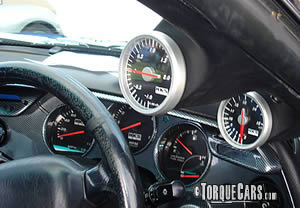
Boost controllers
The turbo is driven by the exhaust gases and the faster the exhaust flows the quicker the turbo spins and more air gets forced in to the engine.
If too much air is forced into the engine then it will run lean. This causes an intermittent loss of power and you also risk putting too much pressure on the engine with a surge of power.
You also risk detonation or knock and the car would be undrivable and unreliable. TorqueCars recommend getting a boost controller setup with a custom tune/remap for reliable power especially on twin turbo engines.
To get around this the makers have fitted a spring valve (the wastegate actuator) to shut down the flow of exhaust to the the turbo which regulates the pressure. For example to get 1 bar of pressure the valve might fully open when 1.3 is achieved.
Please watch our video which explains turbos and all you need to know about them. Be sure to keep up with our latest YouTube content and subscribe.
Then it starts to close again, and when we are back down to 0.7 bar of boost it closes completely. The wastegate actuator is also very gradual in its operation being partially open or closed most of the time effectively restricting the power on offer.
This opening and closing wastegate actuator helps keep an average pressure at 1 bar. But it means that power comes in unsteady peaks, especially on highly tuned engines.
We also need to take into account the fact that when the foot is lifted off the accelerator the air that the turbo sucks in cannot be burned and would just fill the engine until something bursts so this pressure is released - see dump valve or blow off valve for a description of this in more detail.
This means that the turbo effectively spins down because the 1 bar pressure will build up instantly due to the fact that there is nowhere for the air to go, while the engine is at closed throttle (when you lift off the accelerator) so the spring valve driving it is closed.
When you re-apply the throttle and the engine starts burning the air sucked in again the turbo spins up again when the exhaust gases are moving fast enough typically at 2500 rpm or greater - this delay is called turbo lag and can be quite annoying.
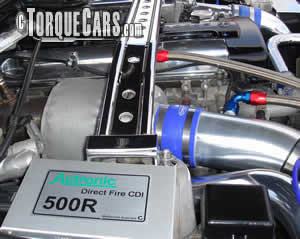 A good boost controller adds an electronic brain to the valve that controls the flow through the turbo and allows much better control of the boost. Instead of peaking at 1.3 and dipping to 0.7 and only allowing full turbo flow at its its peak you can maintain a full boost of 1.3 at wide open throttle.
This also means you have a much quicker response when the throttle is applied and the wastegate actuator will match the throttle position with the amount of boost given rather than just averaging around a safe setting.
Some boost controllers can effectively double the amount of boost at full throttle and give more power throughout the rev range.
Mechanical boost controllers are clunky things that do little more than allow a bit of tweaking to the threshold at which the wastegate is fully open and a switch can be added that allows you to change the setting from inside the car but these are still subject to fluctuation and are quite different from a fully mapped electronic boost controller.
Boost controllers will increase the power gains from the turbo but it is up to the engine management to set the fuelling. It will use readings from the AFM, MAP or MAF and Lambda sensor to determine this. If these sensors are faulty the car will run into limp home mode at relatively low boost pressures.
Combine a boost controller on a twin turbo engine along with a good custom tune/remap for the best of both worlds.
On single turbo applications a tune/remap will generally be all you need but it does sometimes pay to uprate the standard wastegate if it is known to be restrictive or slow to operatre.
Further reading - in depth articles about turbos.
- Intro to turbos
- Turbos vs superchargers
- Fitting Turbo to a NA (naturally aspirated) engine
- Turbo upgrades
- Hybrid Turbos
- Twin Scroll Turbos
- Boost Controllers
- Screamer pipes
Why not join our forum and meet other car tuners where you can discuss the options of boost controllers and tunes or remaps and get a wide variety of friendly suggestions.
Please Check out my YouTube channel, we're regularly adding new content...
 Click to accept YouTube Cookies & Play.
Please share this page with your friends on :


PLEASE HELP: I NEED YOUR DONATIONS TO COVER THE COSTS OF RUNNING THIS SITE AND KEEP IT RUNNING. I do not charge you to access this website and it saves most TorqueCars readers $100's each year - but we are NON PROFIT and not even covering our costs. To keep us running PLEASE Donate here
If you liked this page please share it with your friends, drop a link to it in your favourite forum or use the bookmarking options to save it to your social media profile.
Feedback - What do You Think?
Please use our forums if you wish to ask a tuning question, and please note we do not sell parts or services, we are just an online magazine.
Help us improve, leave a suggestion or tip
Please watch this video and subscribe to my YouTube channel.