
 MENU
MENUPorting and gas flowing engine heads.
"Your first PORT of call."
Porting an engine
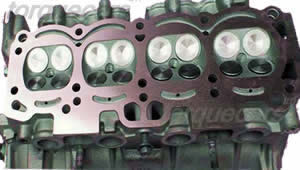 The inlet and outlet ports on the engine block are usually larger than those of the manifolds that connect to them.
This allows for scope in the manufacturing process to allow for mismatched alignment.
Generally the engine ports are larger in the upstream flow direction avoiding turbulance but power gains can be made by matching these up.
Most internal surfaces are far from smooth due to the casting process so small gains are there to be had by smoothing out the rough edges although polishing the insides offers little if any extra gain. Engines need to breathe as freely as possible and obstructions, seams and pits cause turbulence and this is not very good for airflow.
Generally speaking most standard non performance cars will benefit greatly from even a little DIY head porting.
A high performance engine usually comes with a fairly optimum flow and these can only be improved by a specialist with a proper flow bench. (The S2000 is a good example of this anomaly.)
The air intake port would not benefit much by opening up to match the intake manifold, unless there is a step that obstructs the airflow into the engine. So most DIY port matching work is best performed on the exhaust ports.
It is worth noting that enlarging the port size is not always beneficial and is only required in highly tuned engines where the port size has become a bottleneck. Often better flow rates are achieved with slightly narrower channels and fewer bends or angles.
A word of caution though if you enlarge the exhaust port fully to the size of the gasket when the manifold port opening is smaller than the gasket you will completely mess up the airflow. This will lose power - the aim here should be to get the two port openings to roughly the same size avoiding turbulence on the exhaust side.

This picture shows the aim of getting a smooth join between the manifold (x) and the engine port (y) in a highly tuned rally car engine.
The Fuel injector (f) indicates the limit to intake manifold polishing. A rough surface after the injector will help with fuel atomization due to the greater surface area.
Ideally you want the intake directly above the cylinder but this is not possible due to valves and spark plugs and cam assemblies.
Many manufacturers take the intake through a 90 degree bend into the cylinder. The straighter you can make the intake path the better it will be.
Additionally the intake side of the head will benefit if you can create a Spiral flow into the cylinder as this gives much better fuel atomization. Careful work around the valve can help with this further.
TorqueCars members have done a satisfactory DIY job on their heads but a specialist really has so much more to offer. Really, as far as a DIY approach goes, do little more with the ports and manifolds than a smoothing up and polishing (the intake manifold has the job of assisting with vaporizing the fuel and benefits from a pitted rough surface so please do not polish the intake manifold downstream of the fuel injectors marked f in fig1!).
Polishing should not happen after the injector as the port can be reshaped but there must be a slightly rough finish to help the fuel mix better with the incoming air.
Air flows in a similar way to water, the faster the air moves the more gloopy and sticky it behaves. If you have ever hit the surface of water at speed you will realise that it is not soft and liquid!
The aim in the head is to get as much air and fuel mixed as effectively as possible into the combustion chamber. The most important area within the engine, as far as air flow is concerned, is the valve seats and bigger power gains can be has here especially for engines with slightly higher lift valves with some careful blending below the valve seat insert to remove the steps and grooves.

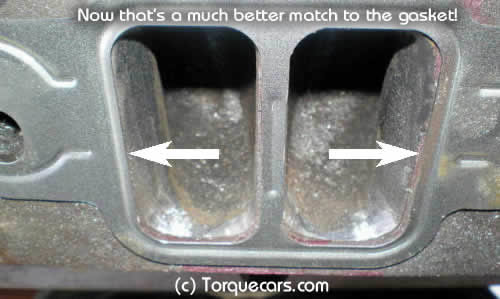
Concentrate on a clean flow into the engine rather than just widening the inlet and exhaust ports. Bigger is not always better.
Beware, not all engines benefit from the inlet ports being opened up to the size of the gasket. NA (naturally aspirated) engines rely on the vacuum created by the engine to suck in air, and widening the inlet port will actually slow up the flow of air, sacrificing low end power but it will generally allow more mixture to be introduced at high RPM. The port sizes should be setup for the optimum desired characteristics of each engine.
In a turbo or supercharged engine bigger is usually better as the air is being forced into the engine but the entire inlet and exhaust channel should match the dimensions of your new port sizes.
Putting the gasket over the ports will show how much can be taken off for a good airflow match but you will rarely want to go as wide as the gasket. Use some nail varnish to mark the area then remove the gasket and start cutting away with a grinding wheel in slow, long deliberate arc movements.
The angles on the valve seats is also of concern to the engine tuner. Generally speaking, the thinner the seat, the more unreliable the engine will be so we are back to the eternal compromise of power vs reliability. A progressive 3 or 5 angle step will greatly help the air intake around the valves.
Because each engine type is different with some producing more heat than others, various cylinder configurations from an inline 4 to a W8 and a wide variety of 24v 20v 16v and 8v it is almost impossible to give a one for all guide to porting. For best results we always recommend leaving head work to professionals who are able to measure the airflow through the head and help create the perfect head setup for you.
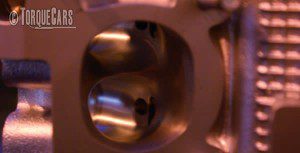 Each type of engine is better suited to a specific valve seat shape just as your driver requirements will create a different range of properties that the head machinist has to work to.
Fitting larger valves will generally improve the airflow through the head of the engine into the combustion chambers and will help the engine cope with a much higher state of tune.
Adding longer valve stems will also release a little more power too in many engines although you really need to avoid the possibility of a valve hitting the piston and you still need the valve to fully close!
Caution – if you mess up the airflow you can end up ruining the engine. It is possible to cause an imbalance of airflow to each cylinder and it is equally possible to ruin the bottom end power.
Please Check out my YouTube channel, we're regularly adding new content...
 Click to accept YouTube Cookies & Play.
Please share this page with your friends on :


PLEASE HELP: I NEED YOUR DONATIONS TO COVER THE COSTS OF RUNNING THIS SITE AND KEEP IT RUNNING. I do not charge you to access this website and it saves most TorqueCars readers $100's each year - but we are NON PROFIT and not even covering our costs. To keep us running PLEASE Donate here
If you liked this page please share it with your friends, drop a link to it in your favourite forum or use the bookmarking options to save it to your social media profile.
Feedback - What do You Think?
Please use our forums if you wish to ask a tuning question, and please note we do not sell parts or services, we are just an online magazine.
Help us improve, leave a suggestion or tip
Please watch this video and subscribe to my YouTube channel.
2 Responses to “Principles of porting an engine and big valve conversions”
I believe there is a golden ratio between inlet and exhaust valve sizes. Obviously this will vary between naturally aspirated and forced induction but do you have an info about this?
I’ve also noted over the years that many high torque/low revving engines have a quite large inlet but a very small exhaust valve. The theory is that this improves low end torque. Any thoughts on this?
A very risky procedure if someone is not an expert of counting the intake’s airflows. If anyone trying a DIY methodology without counting the air speed, the injector’s flow and the angle of valve’s stem, the almost sure result is to destroy the backpressure which is crucial on engine’s smooth operation. It is possible to have also misfires, or even a burned valve!!!!