
 MENU
MENUEssential items to have in your cars toolkit.
"Prepare for the worst and you wont be disappointed!"

We never know when we are going to breakdown and a few simple tools in the car will often mean we can get the car going again.
You certainly don't want to be carrying a full set of tools.
So we have thrown out all the non essential and come up with a list of the most useful tools and repair items to carry in your car.
Bottle of engine oil. 1 litre of oil can be enough to top up if you get dangerously low and the oil warning light goes on. Running out of oil WILL cause the engine to seize up. You can also use the engine oil to help lubricate seized nuts and screws and can make the difference between undoing something and fixing it or being stuck at the side of the road.
Screwdrivers, A Phillips cross head and flat screwdriver that will fit most of the screws in the car. When choosing a screwdriver make sure it is good quality - the last thing you want is for the screwdrivers end to burr off the screw or worse just break on you.
A Swiss Army knife is also a helpful addition to a tool kit especially if it has a saw and few good sharp blades.
Socket set. Each car probably only has 2 or 3 main bolt sizes so make sure that you have the correct sizes with you, carrying smaller and larger socket sizes is just a waste of space and adds to the cars weight.
Metallic tape. This is great for fixing exhausts and a double wrap over a hole can enable you to limp home without filling the car with dangerous exhaust fumes. Metallic tape is also good for sealing leaking water hoses and air hoses - again use a double wrap around the area. Gaffer, or elephant tape are also good to carry with you at all times but will not stand up to much heat especially if applied to the exhaust making metallic tape the object of choice. The strengths of gaffer tape lie in its ability to bond to wet surfaces making it ideal for fixing water related leaks.
A good sturdy piece of rope which can double up as a tow rope when doubled up or can replace a broken alternator belt.
Rubber bands. These are great for bodging all manner of repairs and can be used to give grip on components which may be covered with oil.
Small torch. Yes you nearly always break down at night and often in the rain. A small torch will enable you to see better and can highlight leaks of water, oil and exhaust gases easily.
Clear Plastic sheet. This can repair a broken window with the use of the tape you carry and can provide a dry surface to work on if the ground is wet.
Length of household electrical wire. You can use this to repair a broken alternator belt, or tie on a loose component or body panel. Also if you have electrical problems you can sometimes use the wire to carry the voltage needed to or from the battery. IF replacing a HT lead with household wire please use all 3 wires to help cope with the high voltages. A single wire would quickly burn out and become a fire hazard. Run the engine and just touch the wire lightly to see if it is getting warm - if it is exercise extreme caution as an engine fire is the last thing you need.
A set of good quality (long) jump leads. Sometimes the battery is just about to give up on you and a jump start will get things moving. Getting another motorist to jump you is fairly easy when you have the leads, hold them up and wait for someone to take pity on you.
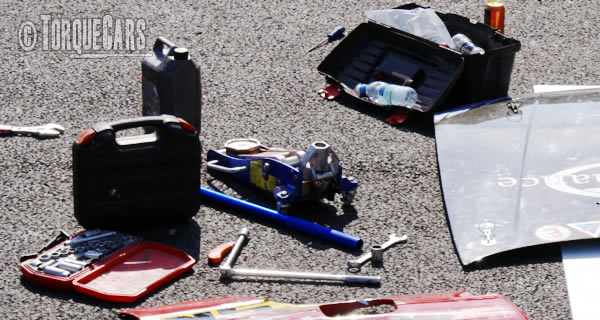
A Jack and wheel brace. Most cars have these and if you get a flat tyre which is probably one of the most common causes of roadside problems you will be thankful that you have these along. The jack can also be used if you need to push out a dented panel following a minor accident or you can use it to pull or push something that is stiff. For example I had to bodge a clutch cable repair where the plastic retainer had broken and I needed to use the jack to force the clutch pedal up as it was too stiff to do this by hand.
A pair of latex or rubber gloves. Kitchen gloves are ok for this as are disposable plastic gloves. You just want to keep the much off your hands as there is rarely a place to clean up afterwards and messy hands will get all over the cars interior and muck up your clothes.
A mobile phone - if all else fails ring for help!
Please Check out my YouTube channel, we're regularly adding new content...
 Click to accept YouTube Cookies & Play.
Please share this page with your friends on :


PLEASE HELP: I NEED YOUR DONATIONS TO COVER THE COSTS OF RUNNING THIS SITE AND KEEP IT RUNNING. I do not charge you to access this website and it saves most TorqueCars readers $100's each year - but we are NON PROFIT and not even covering our costs. To keep us running PLEASE Donate here
If you liked this page please share it with your friends, drop a link to it in your favourite forum or use the bookmarking options to save it to your social media profile.
Feedback - What do You Think?
Please use our forums if you wish to ask a tuning question, and please note we do not sell parts or services, we are just an online magazine.
Help us improve, leave a suggestion or tip
Please watch this video and subscribe to my YouTube channel.
One Response to “Essential toolkit to help you avoid breakdowns.”
good stuff i keep a tyre repair aerosol for inflating a puncture and mending the hole never used it but they must be good enough to get you to a garage never heard any bad reports.